Google Pigeon Update: How It Changed Local Search Results

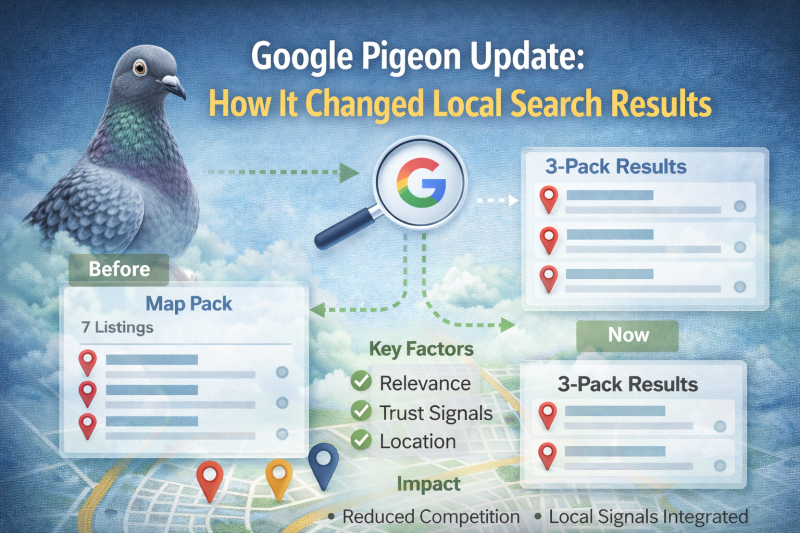
Infographic explaining the Google Pigeon update and how it changed local search rankings and map results for businesses

Table of Contents

Google introduced the Pigeon update in August 2013 with a clear objective: to improve the accuracy and relevance of local search results. While the update initially caused noticeable disruption for many businesses, its long-term impact reshaped how Google evaluates local visibility.

Rather than operating as a standalone change, Pigeon fundamentally altered how local search results are connected to Google’s main web algorithm — a shift that still influences local SEO today.

What the Google Pigeon Update Was Designed to Do

Before Pigeon, local search results were often loosely connected to organic rankings. Pigeon narrowed that gap.

The update strengthened the relationship between traditional organic ranking signals and local search visibility. As a result, businesses with weak websites, poor content, or limited authority began to lose visibility — even if they were physically close to the searcher.

Early versions of Pigeon also relied heavily on distance and location parameters. This initially caused many legitimate businesses to drop out of local results, particularly in competitive areas. Over time, Google refined how proximity is calculated, balancing distance with relevance and trust.

Why Local Content Matters More Than Ever

One clear takeaway from Pigeon — and subsequent local updates — is the importance of local relevance.

Websites that clearly demonstrate a connection to their service area tend to perform better in local results. This includes:

  • Publishing content that references the local area naturally

  • Using locally relevant images and examples

  • Creating service pages that reflect real locations and customer intent

The goal is not to force location keywords, but to show Google that your business is genuinely relevant to users searching in that area.

Diagram showing how the Google Pigeon algorithm reduced local search results from the 7-pack to the 3-pack


From the 7-Pack to the 3-Pack

One of the most visible changes associated with Pigeon was the reduction of local listings from the old “7-pack” format to the now-familiar 3-pack.

This change significantly increased competition. With fewer businesses displayed, small differences in optimisation began to have a much larger impact on visibility. Ranking in the local pack became closely tied to organic performance, website quality, and trust signals.

Businesses that invest in strong on-site SEO, clean technical performance, and authoritative content are far more likely to appear consistently in the 3-pack.

Reviews, Website Quality, and Trust Signals

Pigeon also reinforced the importance of trust.

Positive reviews, consistent business information, and a fast, usable website all send strong signals to Google. These factors influence not only rankings, but also whether users choose to click and engage once your listing appears.

Industry research has consistently shown that local SEO success is built on a combination of:

  • Accurate business details (NAP consistency)

  • Genuine customer reviews

  • Domain authority

  • High-quality, relevant content

No single factor works in isolation.

Handling Spam and Fake Listings

One unintended side effect of early local updates was the rise of spammy or fake business listings. While Google has improved detection over time, user reports still play an important role.

Reporting clear violations helps protect legitimate businesses and improves the overall quality of local results. However, reports should always follow Google’s guidelines and should never be used to target legitimate competitors unfairly.

Final Thoughts

The Google Pigeon update marked a turning point in local search. It shifted the focus away from shortcuts and proximity alone, and toward relevance, quality, and trust.

For businesses today, the lesson is simple: strong local visibility is built on solid foundations. A credible website, useful content, genuine reviews, and ethical optimisation practices will always outperform attempts to game the system.

If your local rankings fluctuate, it’s rarely due to a single update. More often, it reflects how well your site aligns with what Google now expects from trustworthy local businesses.

FAQs – Google Pigeon Update

What is the Google Pigeon update?

The Google Pigeon update is a local search algorithm change that strengthened the connection between local results and Google’s core web ranking signals, improving accuracy and relevance.

Does Google Pigeon still affect local SEO today?

Yes. While Pigeon is no longer a standalone update, its principles are built into Google’s local search systems and continue to influence how businesses rank in map and local results.

How did Pigeon change Google Maps results?

Pigeon altered how Google evaluates distance, relevance, and authority, leading to more refined local results and tighter competition within map listings.

Why did Google reduce local listings from 7-pack to 3-pack?

Reducing the number of listings increased result quality and relevance. It also placed greater emphasis on strong organic SEO, website quality, and trust signals.

What factors matter most for ranking in local search after Pigeon?

Key factors include website quality, relevance to the search query, proximity, business credibility, reviews, and consistent business information.

Can businesses recover lost visibility caused by Pigeon?

Yes. Improving on-site SEO, strengthening local relevance, earning genuine reviews, and maintaining accurate business details can help restore and improve local rankings.


 

Visual showing key local SEO factors such as relevance, location, reviews, and trust signals after the Google Pigeon update

Need Help Improving Your Website or Marketing?

If you need practical support with rankings, website performance or online growth, explore our related services below.

Related Articles

Bright tech illustration showing Technical SEO Support Thailand with indexing checks, sitemaps, redirects, Core Web Vitals, mobile performance, Search Console warnings, and SEO monitoring

Technical SEO Support Thailand: Why Website Issues Can Hold Back Rankings

Technical SEO Support Thailand is important for any business that relies on Google for enquiries, bookings, calls, sales, or long-term online visibility. A website can have useful content and good services, but still struggle in search if technical issues stop Google from crawling, indexing, understanding, or trusting the site properly. Many business owners think SEO only means keywords, blog posts,

Read More »
Bright tech illustration showing Website Monitoring Thailand with uptime checks, speed monitoring, forms, hosting, WordPress checks, backups, security, and SEO alerts

Website Monitoring Thailand: Why Business Websites Need Regular Checks

Website Monitoring Thailand is important for any business that relies on its website for enquiries, bookings, calls, sales, SEO, or customer trust. A website can look fine at first glance while hidden problems affect speed, uptime, forms, security, hosting, backups, or search visibility. Many business owners only notice website problems after a customer complains. A contact form stops sending. The

Read More »
Bright tech illustration showing website speed optimisation in Thailand with Core Web Vitals, fast hosting, image optimisation, WordPress performance, SEO, and technical support

Website Speed Optimisation Thailand: Faster Business Websites

Website Speed Optimisation Thailand is important for any business that relies on its website for enquiries, bookings, calls, sales, search visibility, or customer trust. A slow website can quietly cost a business enquiries because visitors may leave before the page finishes loading. If the site feels slow on mobile, loads poorly on weak connections, or struggles with images, plugins, hosting,

Read More »
Bright tech illustration showing website backup support in Thailand with WordPress backups, cloud storage, recovery planning, hosting, security, and technical support

Website Backup Thailand: Why Business Websites Need a Recovery Plan

A business website needs more than a live server and a working homepage. It also needs a clear backup and recovery plan, so the business knows what happens if the website breaks, gets hacked, loses content, or suffers from a failed update. Many businesses only think about backups after something goes wrong. A plugin update breaks the layout. A page

Read More »
Bright tech illustration showing website security in Thailand with SSL checks, backups, WordPress updates, hosting support, forms, user access, and monitoring

Website Security Thailand: Simple Checks Every Business Website Needs

Website security should not only become a concern after something goes wrong. A business website needs regular checks, strong access control, safe updates, backups, secure hosting, SSL protection, and someone who can spot small risks before they turn into bigger problems. Many businesses assume their website is safe because it still loads. However, a website can look normal while weak

Read More »
Bright tech illustration showing WordPress maintenance in Thailand with plugin updates, backups, speed checks, security, hosting support, and website monitoring

WordPress Maintenance Thailand: Why Business Websites Need Regular Checks

After launch, a WordPress website still needs regular care. Your business should check updates, review plugins, confirm backups, watch security basics, test speed, and make sure the site continues to support real enquiries. Many companies only notice WordPress maintenance when something goes wrong. A form stops sending. A plugin breaks the layout. The website becomes slow. An update causes an

Read More »
AdvertisingAlgorithmsbacklinksblack hat seoblogging for seoBusiness Website Hostingbusiness website hosting thailandBusiness Website Supportbusiness websitesCDN Thailandcontentcontent marketingcontent optimisationconversion rate optimisationconversion trackingCore Web Vitalsdigital marketing fundamentalsdigital marketing Pattayadigital marketing strategydigital marketing thailandGoogleGoogle algorithm updatesgoogle algorithmsgoogle analyticsGoogle Business Profilegoogle business profile optimisationgoogle business profile pattayagoogle maps optimisationgoogle maps rankinggoogle maps seoGoogle ranking factorsGoogle rankingsGoogle Search Consolegoogle toolsgoogle updateshosting thailand businesseskeyword researchlink buildinglocal business pattayalocal business seolocal search visibilitylocal SEOlocal SEO Pattayalong tail keywordslong term seomanaged hostingManaged Web Hosting ThailandManaged Website Supportmanaged WordPress hostingmobile SEOon-page SEOonline visibilityorganic searchorganic seo strategypattaya businesspattaya business marketingpattaya web designprofessional web designprofessional website managementresponsive designresponsive web designresponsive website PattayaSearch Consolesearch engine optimisationSEOseo agency pattayaSEO basicsSEO best practicesseo content writingSEO PattayaSEO penaltiesseo ready websitesseo services pattayaSEO strategySEO ThailandSEO tipsSocial mediatechnical seoTechnical SEO Support ThailandUser experienceuser experience designUser friendlyweb designweb design Pattayaweb designer pattayaweb development Pattayaweb hosting Pattayaweb hosting ThailandWebsite Backup Thailandwebsite design pattayawebsite maintenancewebsite managementWebsite Management ThailandWebsite Monitoring Thailandwebsite optimisationwebsite performancewebsite securityWebsite Security Thailandwebsite speedWebsite Speed Optimisation ThailandWebsite Support Thailandwebsite updateswebsite usabilitywebsite visibilitywhite hat seoWordPress BackupsWordPress hosting ThailandWordPress Maintenance ThailandWordPress PattayaWordPress SecurityWordPress SpeedWordPress Support ThailandWordPress updateswordpress web design pattaya

Ready to Improve Your Website Performance?

Whether you need better design, stronger SEO, or a faster WordPress setup, we build websites that support real business growth — not just visuals.