
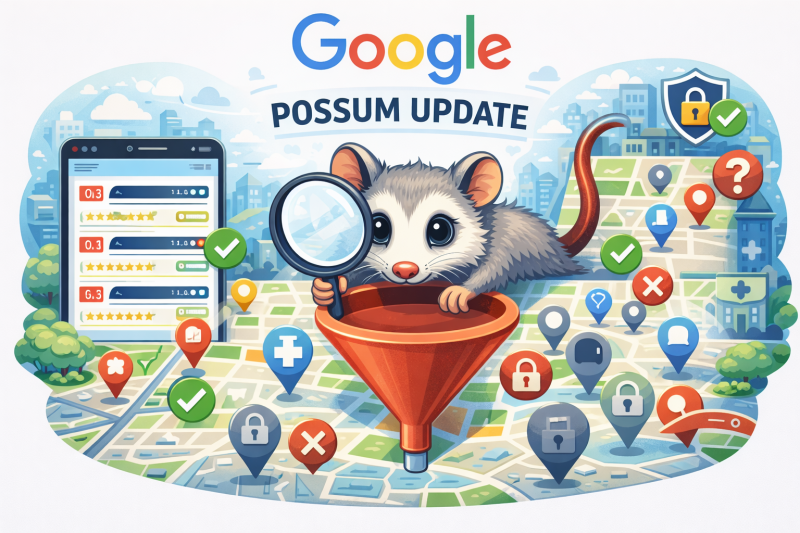
Google’s Possum update, released in September 2016, quietly reshaped how local search results work. While many businesses believed they had been penalised, Possum is not a punishment system. Instead, it acts as a filter, changing which businesses appear in local results depending on context.
For service-based and location-dependent businesses, understanding Possum is essential to maintaining visibility in Google’s local search results.
What Is the Google Possum Update?
Google Possum is a local search filtering update designed to increase result diversity and reduce spam. Rather than removing businesses from Google, Possum decides which listings to show for a specific user, location, and query.
This means:
-
Your business may rank for one user but not another
-
Rankings can change based on searcher location
-
Similar businesses may be filtered out to avoid duplication
This update works closely with other local algorithms such as Pigeon and Google’s proximity signals.
Why Do Businesses “Disappear” From the Local 3-Pack?
One of the most common effects of Possum is businesses appearing to vanish from Google’s local 3-pack. In reality, they are often filtered, not penalised.
A simple test:
-
Search for your service + location
-
If your business does not appear, zoom in on the map
-
Many filtered businesses reappear once Google narrows the search radius
This behaviour shows how heavily location relevance now influences local rankings.
How Searcher Location Affects Local Results
Possum places strong emphasis on where the searcher is physically located. Two users searching the same phrase can see entirely different results depending on proximity.
For example:
-
A user searching “electrician near me” from one street may see different results than someone searching from another neighbourhood
This reinforces the importance of:
-
Accurate location signals
-
Strong on-page local relevance
-
Consistent business data across the web
Shared Business Addresses and Filtering
Businesses operating from:
-
Office blocks
-
Business parks
-
Shared commercial addresses
are commonly affected by Possum. Even when businesses have:
-
Different names
-
Different phone numbers
-
Suite or unit numbers
Google may still filter listings if it believes results are too similar.
This is one of the most frustrating effects of Possum for legitimate businesses, particularly professional services and consultants.
City Boundaries and Ranking Improvements
Interestingly, Possum helped some businesses rather than hurting them.
Before the update, businesses outside city limits struggled to rank for city-based searches. Possum relaxed this restriction by placing more emphasis on distance and relevance, rather than strict administrative boundaries.
As a result:
-
Businesses just outside city borders can now rank competitively
-
Search visibility became more realistic and user-focused
How to Work With the Google Possum Update
Possum is not something you “recover” from. Instead, you optimise around it.
Key actions include:
-
Strengthening location-specific content
-
Improving on-page SEO signals
-
Ensuring NAP consistency across directories
-
Building locally relevant backlinks
-
Optimising your Google Business Profile
Most importantly, focus on being the best local answer, not just another similar listing.
SEO services in Pattaya
Google Pigeon algorithm explained
Final Thoughts on Google Possum
Google Possum changed how local search visibility works, but it did not make rankings unfair. Instead, it made them more contextual, location-aware, and user-focused.
Businesses that invest in:
-
Strong local SEO foundations
-
Clear geographic relevance
-
High-quality, trustworthy content
continue to perform well despite filtering.
If your local visibility has become inconsistent, it is usually a signal to refine your local SEO strategy, not a reason to panic.
Local search visibility now depends on far more than simply having a business listing. Businesses must combine a well-optimised Google Business Profile, accurate local SEO signals, and strong website quality to compete effectively in local results. Our Google Business Profile Pattaya guide explains how businesses can improve local visibility more effectively.
FAQs: Google Possum Algorithm
What is the Google Possum update?
Google Possum is a local search algorithm update released in September 2016. It acts as a filtering system that changes which businesses appear in local results based on relevance, proximity, and search context rather than applying penalties.
Why does my business disappear from the local 3-pack?
In most cases, your business has not been penalised. Possum filters similar listings to increase result diversity. Zooming in on Google Maps often causes filtered businesses to reappear.
Does Google Possum penalise businesses?
No. Possum does not issue penalties or remove listings from Google. It filters results dynamically depending on the user’s location, search phrase, and competing businesses nearby.
How does searcher location affect Possum results?
Possum places heavy emphasis on proximity. Two users searching the same term from different locations can see completely different local results.
Are shared office addresses affected by Google Possum?
Yes. Businesses operating from the same address, such as office blocks or business parks, are commonly filtered. Even separate suite numbers do not always prevent filtering.
Can businesses outside city boundaries rank better after Possum?
Yes. Possum relaxed strict city-boundary rules, allowing nearby businesses outside official borders to rank when they are relevant and close to the searcher.
How can I improve rankings under Google Possum?
You should focus on strong local SEO fundamentals, including consistent NAP details, location-based content, quality backlinks, and an optimised Google Business Profile.
Is Google Possum still relevant today?
Yes. Possum is part of Google’s ongoing local ranking system and continues to influence how local search results are filtered and displayed.