
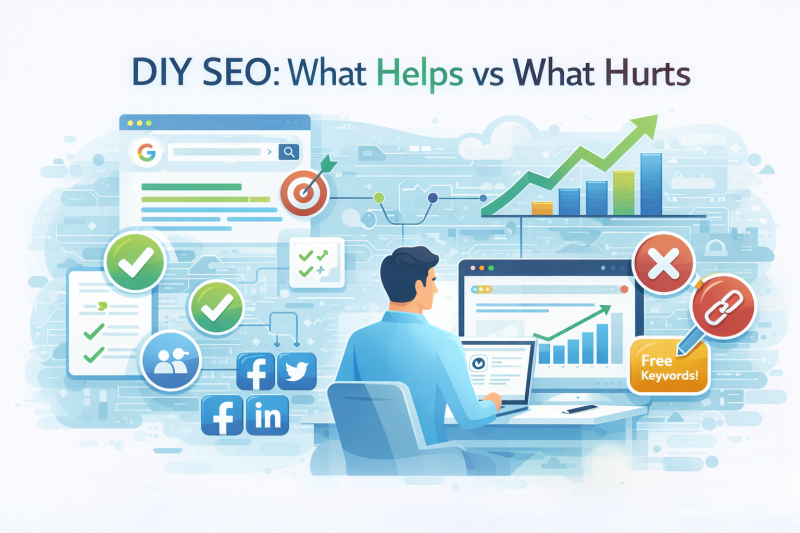
Many business owners ask the same question once they start learning about search engine optimisation: “Can I do anything myself to improve my SEO?”
The short answer is yes—but only if you focus on the right things.
SEO is made up of technical, strategic, and trust-based factors. Some of these should always be handled by professionals. Others are areas where business owners can genuinely add value without risking rankings.
Before looking at what you can do, it’s important to understand what usually goes wrong.
Common DIY SEO Mistakes to Avoid
Working Against Your SEO Team (Instead of With Them)
If you’re working with a professional SEO provider, the most effective approach is collaboration—not independence.
SEO works best when everyone follows one clear strategy.
Making changes without consulting your SEO team—publishing content, building links, or changing pages independently—can easily dilute or damage progress. You’re paying for expertise, so use it. Let your SEO specialists guide priorities while you support execution.
This is exactly how effective SEO campaigns in Pattaya and competitive markets are run.
Letting “Helpful” Friends Work on Your Website
One of the most common SEO mistakes is allowing a well-meaning friend to “help” because they are “good with tech” or “know a bit about websites.”
SEO is not about repeating actions endlessly. Posting the same comment, link, or social message across multiple platforms signals manipulation—not authority.
Search engines actively filter this behaviour.
What works in SEO is moderation, relevance, and uniqueness, not volume.
Copying Someone Else’s SEO Strategy
This mistake is easy to make—and costly.
Just because a competitor ranks well does not mean copying part of their strategy will work for you. You never see the full picture:
-
Domain history
-
Backlink profile
-
Content depth
-
Technical structure
-
Conversion optimisation
SEO strategies must be custom-built. While the principles remain consistent, execution is always unique. This is why professional search engine optimisation services never use templates.
Buying Links in Bulk
Yes, links still matter.
No, buying random links is never safe.
Bulk link purchases remain one of the most heavily penalised SEO tactics. Google’s systems are extremely effective at identifying unnatural link patterns. A short-term boost often results in long-term damage.
If there is one rule to remember: never buy links without a strategy.
What You Can Do to Support Your SEO
Create Genuine, High-Quality Content
Content remains one of Google’s strongest trust signals.
And no one understands your business better than you.
Publishing useful, relevant content—blog posts, FAQs, service explanations, guides—helps your site grow naturally. Even if your SEO team later refines or optimises it, adding real value always helps.
This is a key pillar of long-term SEO growth for Pattaya businesses and beyond.
Support SEO with Social Media Activity
While social signals are not direct ranking factors, they play an important supporting role.
Active social profiles:
-
Increase brand visibility
-
Drive referral traffic
-
Reinforce trust and legitimacy
If you’re confident with social media, this is an excellent area to manage yourself while your SEO team focuses on technical optimisation, content strategy, and authority building.
Be Consistent and Communicative
SEO works best when business owners and specialists move in the same direction.
Regular communication helps avoid duplicated effort, mixed signals, and wasted budget.
When content, branding, SEO, and conversion goals align, results compound over time—especially when supported by a professional SEO Pattaya strategy.
Final Thoughts
You can help your own website’s SEO—but only by focusing on quality, consistency, and collaboration.
Avoid shortcuts. Avoid duplication. Avoid working in isolation.
Instead, contribute content, support social visibility, and work alongside experts who understand how Google actually evaluates websites.
In the next posts, we’ll break down content, links, and authority signals in more detail—so you can understand why these strategies work and how to support them safely.