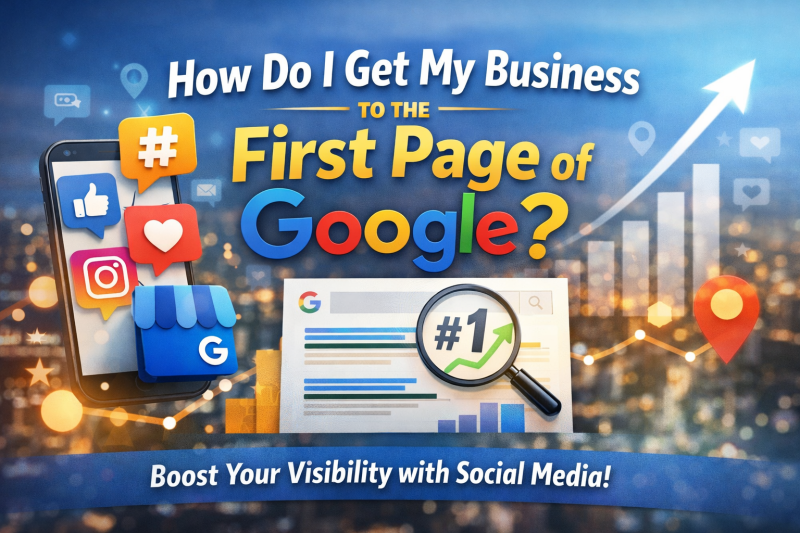
Getting your business on the first page of Google is one of the most important factors in generating consistent enquiries online. With most users never clicking past page one, improving your visibility requires more than basic SEO. In this guide, we explain how social media supports first page of Google rankings by strengthening trust signals, brand authority, and user engagement.
In this guide, we explain how social media contributes to first-page visibility, how it interacts with Google’s algorithms, and how to use it properly as part of a wider SEO strategy.
Why the First Page of Google Matters So Much
Search behaviour is heavily front-loaded. Most users never move past the first page, and the majority of clicks happen within the top five results. If your business does not appear early, it may as well be invisible for that search query.
Google’s objective is simple:
show users the most relevant, trustworthy, and useful result as quickly as possible.
To do this, Google evaluates far more than keywords. It looks at:
-
Brand presence across the web
-
Consistency of information
-
Engagement signals
-
Authority and trustworthiness
-
User behaviour after clicking
This is where social media quietly supports SEO.
Does Social Media Directly Affect Google Rankings?
No — social media is not a direct ranking factor.
However, this is where many businesses misunderstand its importance.
Social media influences rankings indirectly by strengthening the signals Google does care about:
-
Brand legitimacy
-
Entity recognition
-
Trust and credibility
-
User engagement
-
Content discovery
Google’s algorithms are increasingly entity-based. This means Google wants to understand who you are, what you do, and whether users trust you — not just what keywords you target.
Social media helps reinforce those answers.
Social Media as a Trust and Entity Signal
When Google evaluates a business, it cross-checks information from multiple sources. Social media profiles act as supporting entity references, especially when they are:
-
Properly branded
-
Actively maintained
-
Linked back to the website
-
Consistent with business details
Well-maintained social profiles help confirm that your business is:
-
Real
-
Active
-
Recognised by users
-
Worth surfacing in search results
This supports your wider SEO efforts, particularly when combined with a strong on-site strategy such as SEO services in Pattaya.
Consistency Matters: Name, Address, Phone (NAP)
One of the most common mistakes businesses make is inconsistency.
Google expects your:
-
Business name
-
Address
-
Phone number
-
Website URL
to match everywhere online — including social media.
When profiles conflict, Google loses confidence. When they align, Google gains certainty.
Consistent NAP information strengthens:
-
Local SEO
-
Google Business Profile visibility
-
Map pack rankings
-
Brand trust signals
Engagement Signals and User Behaviour
Google cannot see likes and shares in the same way humans do, but it can observe user behaviour that originates from social platforms.
When users:
-
Discover your content via social media
-
Click through to your website
-
Spend time reading
-
Navigate multiple pages
-
Return later via search
Google receives positive behavioural signals.
These signals help Google validate that:
-
Your content satisfies intent
-
Your brand is relevant
-
Your pages deserve visibility
This is especially important for competitive keywords where many sites are similar.
Content Distribution and Indexation Speed
Social media also plays a role in content discovery.
When you publish a new blog post or service page and share it socially:
-
It gets discovered faster
-
It earns early engagement
-
It may attract natural links
-
It avoids appearing dormant
This supports long-term content performance and reinforces freshness — a key factor in many Google updates.
How to Optimise Social Media for SEO Support
To make social media work with your SEO rather than beside it, focus on the following:
1. Fully Optimise Every Profile
-
Use your real business name
-
Add a clear description of services
-
Include your location
-
Link to your website
-
Use consistent branding
2. Link Everything Together
-
Website → social profiles
-
Social profiles → website
-
Google Business Profile → website and socials
This builds a clean entity network.
3. Post Consistently (Not Excessively)
You do not need to post daily everywhere. What matters is:
-
Regular activity
-
Relevant content
-
Clear business messaging
Abandoned profiles can hurt trust.
4. Encourage and Respond to Engagement
-
Reply to comments
-
Acknowledge reviews
-
Show human interaction
This strengthens credibility and user confidence.
Social Media Is Not a Replacement for SEO
It is important to be clear:
Social media supports SEO, but it does not replace:
-
Technical optimisation
-
Content quality
-
Site structure
-
Page speed
-
Internal linking
To reach the first page of Google, social media must work alongside a structured SEO strategy such as professional SEO in Pattaya, not instead of it.
Final Thoughts: Think Ecosystem, Not Tactics
Google no longer ranks websites in isolation. It evaluates brands, entities, and user trust across the web.
Social media helps:
-
Validate your brand
-
Strengthen trust signals
-
Improve engagement
-
Support content performance
When used correctly, it becomes a powerful supporting asset in your journey to the first page — not by gaming the system, but by reinforcing legitimacy.
If you want help aligning social media with your SEO strategy, speak to Proactive Marketing Solutions for tailored guidance.
Google First Page Rankings Frequently Asked Questions
Can social media really help my business rank on the first page of Google?
Social media does not directly influence Google rankings, but it plays an important supporting role. Active, well-optimised social profiles help build brand trust, improve content visibility, and drive engaged traffic to your website. These signals support a broader SEO strategy and work best when combined with a professional SEO services campaign that focuses on long-term visibility and authority.
Does Google use likes, shares, or followers as ranking factors?
No. Google has confirmed that social metrics such as likes, shares, and follower counts are not direct ranking factors. However, social media increases content reach, which can lead to natural backlinks and improved engagement—both of which support organic SEO performance over time.
How does social media support local SEO and Google Maps rankings?
Social media profiles reinforce consistent business information such as name, address, phone number, and website links. When this data aligns with your website and Google Business Profile, it strengthens local SEO signals and improves trust for Google Maps rankings.
Is social media more important for small businesses than large brands?
Yes. For smaller businesses, social media helps establish credibility and brand recognition faster. Consistent posting, customer interaction, and clear service messaging support first-page Google visibility when paired with strong on-site optimisation.
How often should a business post on social media for SEO benefits?
Consistency matters more than frequency. Posting one to three times per week is usually enough, provided the content is relevant and useful. Abandoned profiles weaken trust signals and can undermine your search engine optimisation efforts.
Should social media posts link back to my website?
Yes. Linking social posts back to relevant pages helps drive qualified traffic and strengthens the relationship between your brand and your domain. This supports content discovery, improves engagement, and complements on-page SEO optimisation.
Can social media replace SEO?
No. Social media cannot replace SEO. While it supports visibility and trust, strong rankings still rely on technical optimisation, quality content, internal linking, and performance improvements delivered through a structured SEO campaign.
What social platforms matter most for Google visibility?
Platforms that match your audience matter most. Facebook, Instagram, LinkedIn, X (Twitter), and YouTube often appear in branded searches and support brand authority signals, especially when profiles are fully optimised and linked back to your website.