
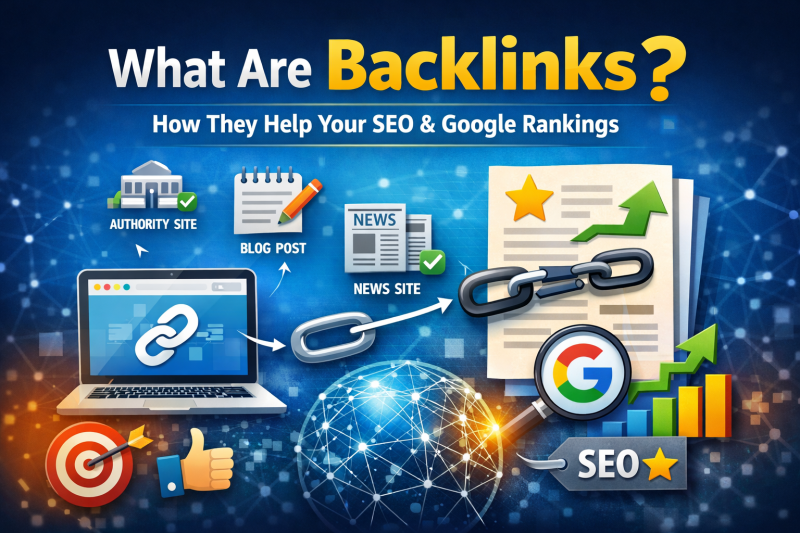
What are backlinks, and why do they matter so much for SEO?
Backlinks are one of the strongest signals Google uses to judge trust, authority, and relevance. In simple terms, when another website links to yours, it acts as a vote of confidence. The more credible the site linking to you, the stronger that signal becomes.
Although most business owners have heard that backlinks are important, very few fully understand how they work, which types matter, and how they actually influence Google rankings.
How Backlinks Work in Google’s Algorithm
Backlinks tell Google three critical things:
-
Trust – Is your site referenced by reputable sources?
-
Authority – Do other websites see your content as valuable?
-
Relevance – Are you being linked to within the right context?
Google’s algorithm does not treat all backlinks equally. One high-quality backlink can outweigh hundreds of low-quality ones. This is why link building for SEO must focus on quality, relevance, and consistency rather than volume.
For a deeper understanding of how algorithms evaluate links, see our guide on Google’s Penguin algorithm update.
Internal Links vs Backlinks (Important Distinction)
Not all links are backlinks.
-
Backlinks come from other websites pointing to yours
-
Internal links connect pages within your own website
Internal linking helps Google understand your site structure and supports crawling, while backlinks build external authority. Both matter, but only backlinks directly influence your site’s perceived popularity.
You can see how this works in practice within our SEO services in Pattaya guide.
How Many Backlinks Do You Need to Rank?
There is no fixed number.
Some websites rank well with a few hundred backlinks, while others need thousands. The difference is quality. Google evaluates backlinks based on:
-
Authority of the linking website
-
Relevance of the linking page
-
Placement of the link within content
-
Natural anchor text usage
-
Overall link profile balance
A steady, natural backlink profile built over time is far safer—and more effective—than aggressive link campaigns.
Earned vs Acquired Backlinks
Google broadly categorises backlinks into two groups:
Earned Backlinks
These happen naturally when someone links to your content because it is useful or authoritative. These are the most valuable and safest links.
Acquired Backlinks
These are links you actively build or request. When done correctly, they can help. When abused or paid for, they can cause penalties.
Google is extremely good at identifying paid or manipulative links, which is why black hat link building often leads to ranking drops.
Common Types of Backlinks
Not all backlink sources carry the same weight. Common types include:
-
Directories and citations (useful for local SEO)
-
Editorial and news mentions (very high value)
-
Blog posts and articles
-
Images and infographics
-
Forums and blog comments (low value unless highly relevant)
A natural backlink profile includes a mix, but leans heavily toward editorial and content-based links.
Anchor Text: Natural vs Risky
Anchor text is the clickable text in a link. Google uses it to understand context.
Natural anchor text example:
“…learn more about how backlinks support SEO rankings.”
Risky anchor text example:
“…the best SEO company in Pattaya.”
Exact-match keyword anchors used repeatedly can trigger algorithmic filters. Variety is essential. Brand names, URLs, partial phrases, and natural language all help keep your link profile safe.
This principle is also reinforced in Google’s Fred and core quality updates.
How Backlinks Improve Long-Term Rankings
When built correctly, backlinks help you:
-
Rank for competitive keywords
-
Build domain authority over time
-
Increase crawl frequency
-
Improve trust signals
-
Support content visibility
Backlinks work best when combined with strong content and technical SEO. Learn how these elements connect in our Google algorithm overview.
Final Thoughts on Backlinks and SEO
Backlinks are not shortcuts. They are signals of trust earned over time.
If your backlink strategy is built on relevance, quality content, and ethical outreach, Google will reward it. If it is built on manipulation, shortcuts, or repetition, Google will eventually remove its value.
When in doubt, focus on creating content worth linking to—and let backlinks follow naturally.
Next Steps
If you want professional guidance on building backlinks safely and sustainably, explore our SEO Pattaya services page.
What Are Backlinks FAQs
What are backlinks?
Backlinks are links from other websites that point to your website. Search engines treat them as signals of trust and relevance, especially when they come from reputable, topic-related websites.
How do backlinks help SEO and Google rankings?
Backlinks can improve rankings by helping Google understand that your content is credible and useful. Strong links can also help Google discover your pages faster and build overall authority for your domain over time.
Are all backlinks equally valuable?
No. A backlink’s value depends on quality factors such as the linking site’s reputation, topical relevance, the page quality, where the link sits on the page, and whether it looks natural.
What is anchor text, and does it matter?
Anchor text is the clickable text of a link. It matters because it helps describe what the linked page is about. However, over-optimising anchor text (repeating exact keywords too often) can look unnatural, so variety is important.
How many backlinks do I need to rank well?
There is no universal number. Some websites rank with relatively few links if they are high quality and the content matches search intent well. In competitive niches, you typically need more authority and stronger link signals.
What’s the difference between “earned” and “acquired” backlinks?
Earned backlinks happen naturally because people choose to reference your content. Acquired backlinks are the result of outreach or placements. Google generally rewards natural, editorial links and can penalise manipulative paid link schemes.
What types of backlinks are best for small businesses?
Usually the best mix includes: relevant local citations, editorial mentions, industry links, partner/supplier links, and genuinely useful content links (guides, resources, tools). The key is relevance and legitimacy.
Can bad backlinks hurt my rankings?
Yes, if you have a pattern of spammy or manipulative links (link schemes, paid networks, irrelevant spam). A small number of low-quality links is common and not usually a problem—risk comes from scale and obvious manipulation.
What are “nofollow” and “dofollow” links?
“Dofollow” links can pass ranking signals. “Nofollow” links typically do not pass the same signals, but they can still drive traffic and credibility. A natural backlink profile often includes both.
Should I buy backlinks?
No. Buying links for ranking manipulation violates Google’s guidelines and can result in ranking losses. A safer approach is earning links through quality content, PR, partnerships, and local/industry visibility.