
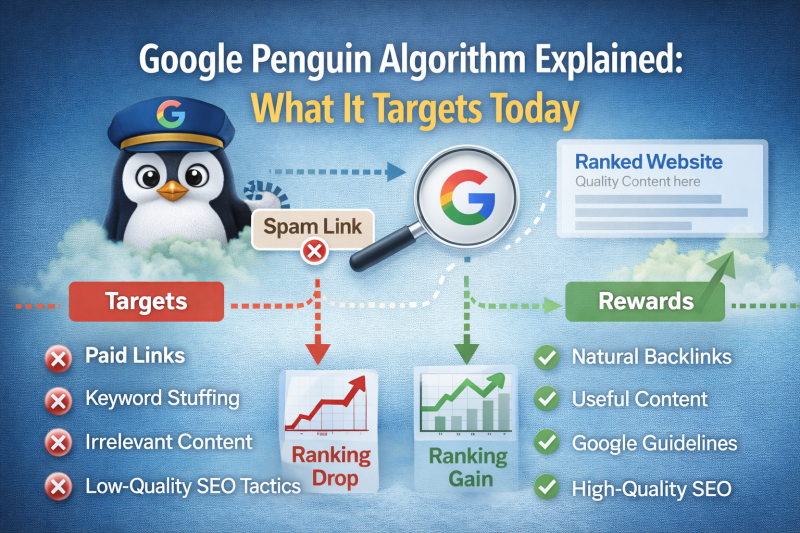
The Google Penguin algorithm was introduced shortly after the Panda update as part of Google’s ongoing effort to improve the quality of its search results. While Panda focused largely on content quality, Penguin targeted manipulative SEO practices — particularly those designed to artificially influence rankings.
Over time, Penguin has evolved significantly. In 2016–2017, it was integrated into Google’s core algorithm, meaning its principles are now applied continuously rather than through occasional, disruptive updates.
The Purpose of Google Penguin
At its core, Penguin exists to protect the integrity of Google’s search results.
It identifies websites that attempt to manipulate rankings through deceptive practices and reduces their visibility, while rewarding sites that follow Google’s Webmaster Guidelines and prioritise genuine user value.
Rather than asking “how can this page rank higher?”, Penguin evaluates “does this page deserve to rank?”

What Penguin Considers Negative SEO Practices
Although SEO tactics have evolved, Penguin still targets the same underlying behaviours: attempts to game the system instead of serving users.
Keyword stuffing
This occurs when keywords are repeated unnaturally in content, headings, or metadata in an attempt to signal relevance. Modern search engines easily detect this pattern and treat it as a sign of low-quality content.
Link schemes
Penguin is especially effective at identifying unnatural backlink profiles. This includes links from irrelevant or low-quality websites, paid link networks, and large volumes of non-editorial backlinks designed purely to inflate authority.
Other practices Penguin devalues include:
-
Hidden text or hidden links
-
Pages targeting irrelevant keywords
-
Doorway pages created solely for ranking
-
Automatically generated or spun content
-
Deceptive or unnecessary redirects
These techniques are not only ineffective today — they actively harm long-term visibility.
How to Stay in Penguin’s “Good Books”
If your website has been affected by Penguin in the past, or if you want to ensure it remains protected going forward, the solution is not shortcuts — it’s cleanup and consistency.
Key actions include:
-
Auditing and removing spammy or low-quality backlinks
-
Avoiding over-optimisation of pages and anchor text
-
Rewriting content to prioritise clarity, usefulness, and natural language
-
Building links organically through relevant content and genuine mentions
Modern SEO is less about manipulation and more about trust signals, relevance, and technical soundness.
Penguin’s Role Today
Because Penguin now operates as part of Google’s core algorithm, its impact is more subtle but more constant. Instead of dramatic ranking drops after updates, poor practices are simply ignored or devalued in real time.
Websites that focus on quality content, clean structure, and ethical optimisation are far more resilient to algorithm changes than those relying on outdated tactics.
Sustainable rankings depend on applying these signals through SEO best practices for businesses, rather than trying to exploit individual updates.
Final Thoughts
Google Penguin continues to favour websites that are safe, trustworthy, and genuinely useful to users. Like other core systems within Google’s algorithm, it rewards transparency and penalises deception.
If your website follows best practices, serves a clear purpose, and aligns with Google’s guidelines, Penguin is unlikely to be something you need to worry about. In fact, it often works in your favour by filtering out competitors relying on poor-quality SEO.
For tailored advice on backlink audits, content optimisation, or long-term SEO strategy, speak with a specialist who understands how modern algorithms actually work — not how they worked a decade ago.
Google Penguin reinforced the importance of natural SEO practices and high-quality link profiles. Today, businesses should focus on sustainable SEO strategies built around helpful content, strong technical foundations, and reputable digital marketing practices rather than manipulative link-building techniques. A properly structured SEO strategy remains essential for long-term growth.
FAQs – Google Penguin Algorithm
What is the Google Penguin algorithm?
Google Penguin is part of Google’s core algorithm that evaluates the quality and trustworthiness of links and on-page optimisation signals. It focuses on reducing the impact of manipulative SEO practices rather than rewarding shortcuts.
Does Google Penguin still matter today?
Yes. Penguin now runs continuously as part of Google’s core algorithm. Instead of causing sudden penalties, it devalues poor-quality links and over-optimised signals in real time.
Can Google Penguin penalise my website?
Penguin does not typically apply manual penalties. Instead, it algorithmically ignores or devalues spammy links and manipulative tactics, which can result in reduced rankings if a site relies on them.
What types of links does Penguin ignore or devalue?
Penguin targets unnatural links such as paid backlinks, low-quality directory links, irrelevant guest posts, and links created purely to manipulate rankings rather than provide value.
How can I recover from Penguin-related ranking issues?
Recovery involves auditing backlinks, removing or disavowing harmful links, improving content quality, and ensuring optimisation follows Google’s guidelines. Sustainable recovery focuses on quality, not quick fixes.
Is keyword optimisation still important under Penguin?
Yes, but keywords must be used naturally. Overuse or forced placement can harm performance, while clear, user-focused content improves both relevance and rankings.