Search engines use hundreds of signals to decide how well pages should rank across different searches. These signals collectively determine how trustworthy, relevant, and useful a website appears — often described broadly as authority.
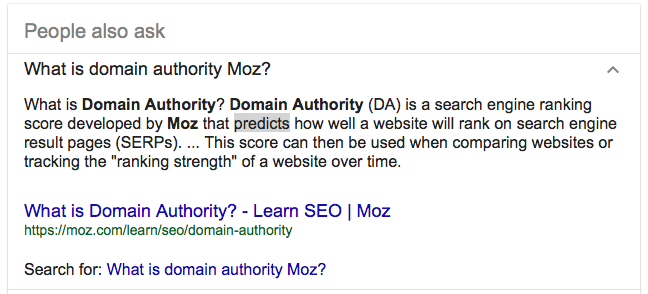
You may also come across the term Domain Authority (DA), popularised by tools such as Moz. It’s important to be clear that Google does not use Moz’s DA as a ranking factor. Google has confirmed this repeatedly. DA is simply a third-party metric designed to predict how likely a site is to rank relative to others.
While these tools can provide useful direction, they should never be treated as definitive. Google’s ranking systems are far more complex and constantly evolving, which is why third-party metrics can only ever approximate reality.
What matters far more is how SEO techniques are applied — and whether they align with how search engines expect websites to behave.
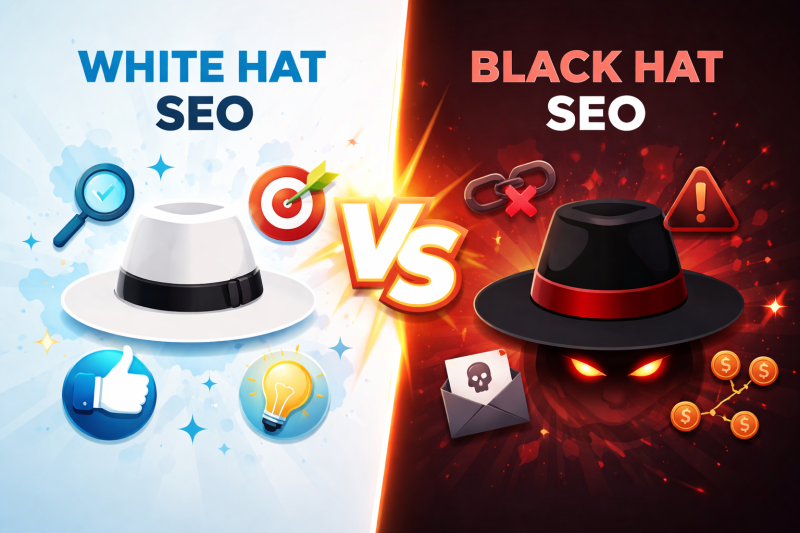
Understanding White Hat and Black Hat SEO
SEO broadly falls into two categories:
-
White hat SEO – ethical, sustainable optimisation focused on users
-
Black hat SEO – manipulative tactics designed to exploit algorithm weaknesses
This distinction sits at the heart of white hat vs black hat SEO and explains why some sites grow steadily while others disappear after algorithm updates.
What Is White Hat SEO?
White hat SEO focuses on earning visibility rather than forcing it. The goal is to align optimisation efforts with user needs and search intent.
Typical white hat approaches include:
-
Creating genuinely useful, original content
-
Structuring pages clearly for users and search engines
-
Earning links naturally through relevance and authority
-
Improving site speed, usability, and accessibility
-
Matching content closely to what people are actually searching for
These white hat SEO strategies work with search engines, not against them. Results take time, but they compound. Sites built this way tend to be more resilient to updates and provide long-term value.
This is the foundation of ethical SEO practices, which is exactly what modern search engines are designed to reward.
What Is Black Hat SEO?
Black hat SEO attempts to manipulate rankings through tactics that prioritise speed over sustainability.
Common black hat SEO techniques include:
-
Keyword stuffing and unnatural repetition
-
Buying or mass-producing low-quality backlinks
-
Hidden text or links
-
Doorway pages and duplicated content
-
Automatically generated or spun content
While these methods may create short-term gains, Google continuously improves its ability to detect manipulation. When patterns are identified, rankings can drop suddenly — or pages can be removed entirely.
Why Black Hat SEO Still Exists
Despite the risks, black hat SEO still exists for one reason: traffic has value.
For businesses unfamiliar with SEO, fast results can look attractive. Unfortunately, many discover too late that shortcuts lead to long-term damage. Even after manipulative tactics stop, the signals they leave behind can continue to affect visibility.
Google rarely forgets behaviour patterns.
When “Good” SEO Turns Into Bad SEO
One of the most misunderstood aspects of SEO is that repetition can turn good tactics into harmful ones.
For example:
-
One high-quality link is beneficial
-
Hundreds of identical links look artificial
-
One well-optimised page improves clarity
-
Over-optimising every page raises red flags
This is why good and bad SEO strategies are often separated not by intent, but by scale and execution. Natural behaviour varies. Manipulative behaviour repeats.
How Businesses Can Protect Themselves
Whether you manage SEO internally or work with an agency, the same practical rules apply:
-
Be cautious of promises of instant rankings
-
Ask how links are earned, not just how many
-
Focus on clarity and usefulness over keyword density
-
Expect transparency in reporting and actions taken
-
If something looks low-quality or deceptive, it probably is
Strong SEO should always be explainable. Sustainable growth comes from applying SEO best practices for businesses, not chasing loopholes.
The Role of Trust and Local Signals
For businesses targeting local customers, trust plays an even bigger role. Reviews, accurate business details, and consistent visibility all contribute to credibility.
These local search trust signals support both rankings and conversions by helping users feel confident in choosing your business.
The Long-Term View of SEO
Search engines reward websites that demonstrate safety, usefulness, and reliability over time. This philosophy underpins major algorithm updates designed to reduce manipulation and promote genuine value.
If your site focuses on helping users and follows established guidelines, it becomes more resilient with every update rather than more vulnerable.
That is the real difference between sustainable SEO and risky shortcuts.
White Hat vs Black Hat FAQs
What is the difference between white hat and black hat SEO?
White hat SEO follows search engine guidelines and focuses on improving content, usability, and trust signals over time. Black hat SEO uses manipulative tactics designed to game rankings, which can trigger algorithmic suppression or manual actions.
Is “grey hat SEO” a real thing?
Yes. Grey hat sits between the two—tactics that may not be explicitly forbidden but are risky or designed primarily to influence rankings rather than help users. What counts as “grey” can change as Google updates its systems.
Can black hat SEO work in the short term?
Sometimes, but it is typically unstable. When detection improves or updates roll out, those gains can disappear quickly, and recovery can take months depending on the issue.
What are common examples of black hat SEO?
Examples include link schemes, keyword stuffing, doorway pages, hidden text/links, spammy redirects, and auto-generated pages created purely to rank rather than to help users.
What are common examples of white hat SEO?
Examples include improving site structure, internal linking, page speed, accessibility, clear headings, helpful service content, expert-led articles, and earning legitimate mentions/links through real value.
How do I know if an SEO provider is using risky tactics?
Watch for vague reporting, unwillingness to explain what’s being done, promises of guaranteed rankings, unusually cheap “link packages,” or sudden ranking spikes driven by questionable backlinks.
What happens if my site gets hit by a penalty or algorithmic filter?
You may see ranking drops, traffic loss, or reduced visibility for key pages. Fixes usually involve removing/neutralising harmful links, improving thin or duplicated content, and addressing technical signals that indicate manipulation.
Is “Domain Authority” a Google ranking factor?
No. Domain Authority is a third-party metric used for estimation. Google uses its own signals and systems to assess relevance, quality, and trust—DA can be useful for benchmarking, but it’s not a Google score.
What is the safest long-term approach for SEO?
A user-first strategy: publish genuinely helpful content, strengthen technical foundations, keep site structure clean, build internal links logically, and earn credibility through real-world trust signals (reviews, mentions, expertise).