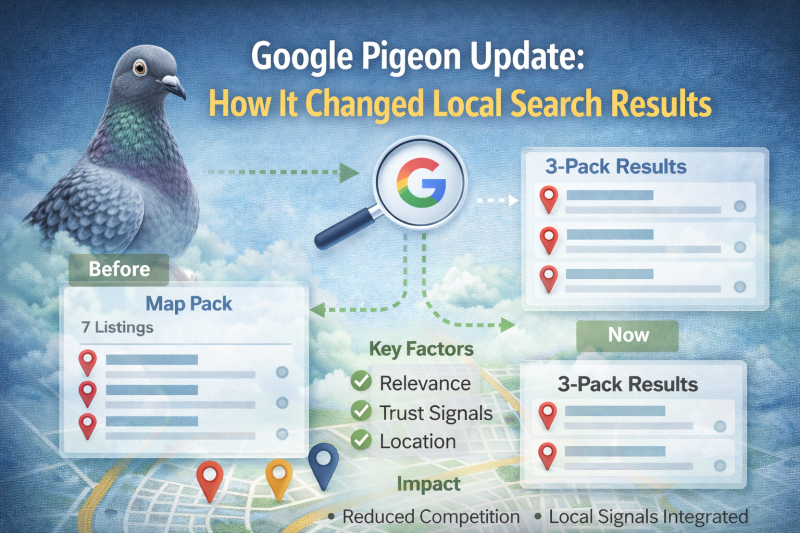
Google introduced the Pigeon update in August 2013 with a clear objective: to improve the accuracy and relevance of local search results. While the update initially caused noticeable disruption for many businesses, its long-term impact reshaped how Google evaluates local visibility.
Rather than operating as a standalone change, Pigeon fundamentally altered how local search results are connected to Google’s main web algorithm — a shift that still influences local SEO today.
What the Google Pigeon Update Was Designed to Do
Before Pigeon, local search results were often loosely connected to organic rankings. Pigeon narrowed that gap.
The update strengthened the relationship between traditional organic ranking signals and local search visibility. As a result, businesses with weak websites, poor content, or limited authority began to lose visibility — even if they were physically close to the searcher.
Early versions of Pigeon also relied heavily on distance and location parameters. This initially caused many legitimate businesses to drop out of local results, particularly in competitive areas. Over time, Google refined how proximity is calculated, balancing distance with relevance and trust.
Why Local Content Matters More Than Ever
One clear takeaway from Pigeon — and subsequent local updates — is the importance of local relevance.
Websites that clearly demonstrate a connection to their service area tend to perform better in local results. This includes:
-
Publishing content that references the local area naturally
-
Using locally relevant images and examples
-
Creating service pages that reflect real locations and customer intent
The goal is not to force location keywords, but to show Google that your business is genuinely relevant to users searching in that area.

From the 7-Pack to the 3-Pack
One of the most visible changes associated with Pigeon was the reduction of local listings from the old “7-pack” format to the now-familiar 3-pack.
This change significantly increased competition. With fewer businesses displayed, small differences in optimisation began to have a much larger impact on visibility. Ranking in the local pack became closely tied to organic performance, website quality, and trust signals.
Businesses that invest in strong on-site SEO, clean technical performance, and authoritative content are far more likely to appear consistently in the 3-pack.
Reviews, Website Quality, and Trust Signals
Pigeon also reinforced the importance of trust.
Positive reviews, consistent business information, and a fast, usable website all send strong signals to Google. These factors influence not only rankings, but also whether users choose to click and engage once your listing appears.
Industry research has consistently shown that local SEO success is built on a combination of:
-
Accurate business details (NAP consistency)
-
Genuine customer reviews
-
Domain authority
-
High-quality, relevant content
No single factor works in isolation.
Handling Spam and Fake Listings
One unintended side effect of early local updates was the rise of spammy or fake business listings. While Google has improved detection over time, user reports still play an important role.
Reporting clear violations helps protect legitimate businesses and improves the overall quality of local results. However, reports should always follow Google’s guidelines and should never be used to target legitimate competitors unfairly.
Final Thoughts
The Google Pigeon update marked a turning point in local search. It shifted the focus away from shortcuts and proximity alone, and toward relevance, quality, and trust.
For businesses today, the lesson is simple: strong local visibility is built on solid foundations. A credible website, useful content, genuine reviews, and ethical optimisation practices will always outperform attempts to game the system.
If your local rankings fluctuate, it’s rarely due to a single update. More often, it reflects how well your site aligns with what Google now expects from trustworthy local businesses.
FAQs – Google Pigeon Update
What is the Google Pigeon update?
The Google Pigeon update is a local search algorithm change that strengthened the connection between local results and Google’s core web ranking signals, improving accuracy and relevance.
Does Google Pigeon still affect local SEO today?
Yes. While Pigeon is no longer a standalone update, its principles are built into Google’s local search systems and continue to influence how businesses rank in map and local results.
How did Pigeon change Google Maps results?
Pigeon altered how Google evaluates distance, relevance, and authority, leading to more refined local results and tighter competition within map listings.
Why did Google reduce local listings from 7-pack to 3-pack?
Reducing the number of listings increased result quality and relevance. It also placed greater emphasis on strong organic SEO, website quality, and trust signals.
What factors matter most for ranking in local search after Pigeon?
Key factors include website quality, relevance to the search query, proximity, business credibility, reviews, and consistent business information.
Can businesses recover lost visibility caused by Pigeon?
Yes. Improving on-site SEO, strengthening local relevance, earning genuine reviews, and maintaining accurate business details can help restore and improve local rankings.