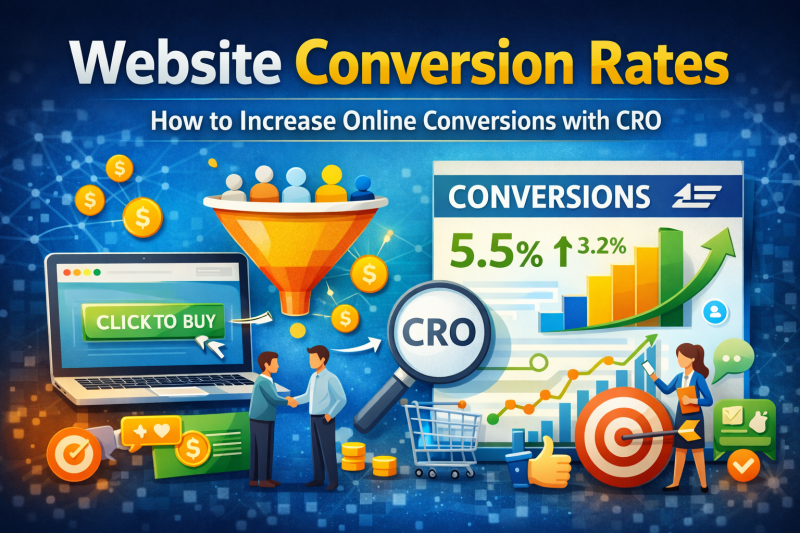
Website conversion rates are one of the most important performance indicators for any business website. They show how effectively a site turns visitors into meaningful actions such as enquiries, bookings, purchases, or sign-ups.
Traffic alone does not equal success. A website with modest traffic but strong conversions will consistently outperform a high-traffic site that fails to turn visitors into customers. Understanding, measuring, and improving conversion rates is essential if a website is expected to generate real business value.
What Is a Website Conversion Rate?
A website conversion rate measures the percentage of visitors who complete a desired action.
That action may include:
- Submitting a contact form
- Booking an appointment
- Making a purchase
- Registering for an account
- Downloading a resource
The basic formula is:
Conversions ÷ Total Visitors × 100 = Conversion Rate
For example, if 1,000 visitors result in 30 enquiries, the conversion rate is 3%.
Why Conversion Rates Matter More Than Traffic
Many businesses focus heavily on increasing traffic. While traffic is important, it is only part of the equation. If visitors do not understand the offer, trust the business, or find it easy to take action, traffic alone produces little return.
Search optimisation brings users to a website, but conversions determine whether that traffic has value. Improving conversion rates is often:
- Faster than increasing rankings
- More cost-effective than buying traffic
- More predictable than long-term traffic growth alone
In many cases, improving conversions delivers results sooner than increasing visitor numbers.
What Is a Good Website Conversion Rate?
Conversion rate benchmarks vary by industry, but general ranges provide useful context:
- Average websites: around 2% to 2.5%
- Well-optimised websites: 4% to 6%
- High-performing websites: 8% to 10% or more
For small and medium-sized businesses, a realistic target is often between 2% and 4%, depending on competition and market conditions.
If a website converts below 2%, there is usually clear room for improvement.
Why Conversion Rates Can Be Difficult to Measure
Tracking conversions is straightforward for e-commerce websites, where purchases are recorded directly. For service-based businesses, measurement can be more complex.
Many conversions happen through:
- Phone calls
- Email enquiries
- Messaging apps
- Offline conversations influenced by the website
Even when tracking is imperfect, indicators such as engagement time, repeat visits, and consistent enquiry growth still provide valuable insight into performance trends.
Common Causes of Low Conversion Rates
Low conversion rates are rarely caused by traffic quality alone. They are more often linked to usability and trust issues.
Common problems include:
- Confusing navigation or layout
- Slow page load times
- Poor mobile usability
- Weak or unclear calls to action
- Missing or hard-to-find contact information
- Outdated or unprofessional design
- Excessive distractions or pop-ups
- Unclear pricing or next steps
If visitors feel uncertain or frustrated, they will leave quickly.
Why Mobile Experience Plays a Major Role
A large proportion of users now browse websites on mobile devices. If a website is difficult to use on a phone, conversion rates will drop sharply.
Simple mobile-focused improvements — such as readable text, fast loading times, and visible contact options — can significantly improve conversions without changing traffic levels.
This is why mobile usability and clarity are essential components of effective web design in Pattaya, where users often browse on the move and compare several businesses before taking action.
(One intentional internal link placed here to support the authority page)
How Conversion Rate Optimisation (CRO) Works
Conversion Rate Optimisation focuses on improving the user journey rather than increasing visitor numbers.
Effective CRO typically involves:
- Clear messaging at the top of each page
- Strong, visible calls to action
- Trust signals such as reviews or credentials
- Logical page flow with minimal friction
- Easy access to contact options
Small changes — such as adjusting layout, wording, or button placement — can produce noticeable improvements.
Why Page Structure Matters for Conversions
Many conversion issues stem from layout and structure rather than content quality. Poor hierarchy, cluttered layouts, or unclear navigation reduce user confidence and slow decision-making.
Well-structured pages guide visitors naturally toward taking action. When usability, clarity, and speed are prioritised during the design process, conversion performance improves as a result.
CRO and SEO Work Best Together
Search optimisation brings visibility. Conversion optimisation turns that visibility into results.
Without CRO, traffic produces limited return. Without SEO, conversion improvements have limited reach. When both work together, performance compounds over time.
Businesses that align optimisation with user-focused design consistently outperform competitors that focus on rankings alone.
Final Thoughts on Website Conversion Rates
Website conversion rates are one of the clearest indicators of how well a website functions as a business tool. Ignoring them can undermine the value of SEO, content, and advertising investment.
By improving usability, clarity, trust, and mobile experience, most websites can achieve meaningful conversion gains without increasing traffic.
If a website attracts visitors but does not generate enquiries or sales, it is not failing — it is simply under-optimised. And that is a problem that can be fixed.
Website Conversion Rates Frequently Asked Questions
What is a good website conversion rate?
A good website conversion rate depends on your industry and business model. For most small and medium-sized businesses, a conversion rate between 2% and 4% is considered healthy. Well-optimised websites can achieve 5% or higher, while top-performing sites may exceed 10%.
Why is my website getting traffic but not converting?
This usually happens when visitors do not clearly understand your offer, do not trust the business, or find it difficult to take action. Common causes include unclear calls to action, slow loading times, poor mobile usability, confusing layouts, or missing contact details.
What is conversion rate optimisation (CRO)?
Conversion rate optimisation (CRO) is the process of improving a website’s design, structure, and messaging so more visitors take a desired action. CRO focuses on usability, clarity, trust signals, and reducing friction rather than increasing traffic.
Is improving conversion rates better than increasing traffic?
In many cases, yes. Improving conversion rates is often faster and more cost-effective than increasing traffic through SEO or advertising. Doubling your conversion rate usually delivers more immediate results than doubling website visitors.
How does SEO affect conversion rates?
SEO brings relevant visitors to your website, but conversions depend on how well your site guides users toward action. Strong SEO combined with poor usability leads to wasted traffic. The best results come when SEO and conversion-focused design work together.
How can mobile optimisation improve conversions?
A large percentage of users visit websites on mobile devices. Mobile optimisation improves conversions by ensuring pages load quickly, content is readable, buttons are easy to tap, and contact options like phone numbers are clickable.
Can small design changes really improve conversion rates?
Yes. Small changes such as improving button placement, adjusting spacing, clarifying headlines, or simplifying forms can lead to noticeable increases in conversions. CRO often focuses on incremental improvements that compound over time.
How often should conversion rates be reviewed?
Conversion rates should be reviewed regularly—at least monthly. Seasonal changes, new competitors, pricing updates, or website changes can all impact performance. Ongoing monitoring helps identify issues early and maintain steady improvement.