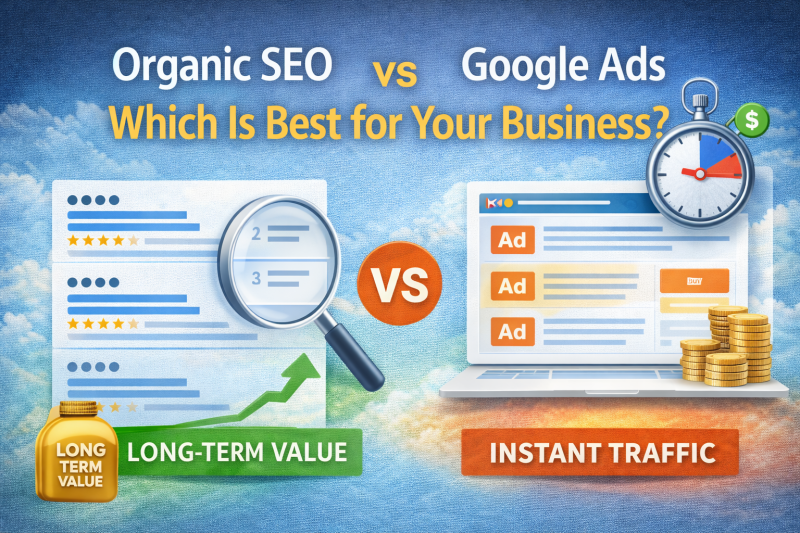
When people search on Google, they see two types of results: paid ads at the top, and organic listings that earn their position naturally. Most business owners understand this difference. The real question is not what’s the difference, but which approach actually makes sense for your business.
The honest answer is not SEO or Google Ads. It depends on your goals, your market, your budget, and how your customers make decisions online.
Why the “SEO vs Ads” Question Isn’t One-Size-Fits-All
In an ideal world, many businesses would use both organic SEO and paid advertising together. Each supports the other when budgets allow. In reality, especially for small and medium-sized businesses, that isn’t always practical.
Budget limits, operational capacity, and return on investment all matter. For example, a local service business such as a dentist, plumber, or clinic can only handle a certain volume of new enquiries. Spending heavily on ads may generate leads faster than the business can realistically serve, making the cost hard to justify.
This is why understanding how your customers search and what influences their decisions is more important than choosing a tactic based on trends or promises of quick wins.
How Google Ads Perform in Different Business Models
Google Ads (formerly AdWords) can work exceptionally well in the right scenario.
For eCommerce businesses, paid ads often perform strongly because customers already know what they want. When someone searches for a specific product, such as a branded perfume or electronic item, the decision is usually based on price, availability, and delivery speed. Google Shopping ads fit perfectly into that mindset.
Service-based businesses are different.
When someone looks for a dentist, lawyer, or local contractor, trust plays a much larger role. Reviews, reputation, proximity, and credibility matter more than simply appearing first. Because anyone can pay to appear in ads, users are often more cautious about clicking them. This typically results in lower click-through rates and higher bounce rates for service-based Google Ads campaigns.
A useful question to ask yourself is simple: do you personally click on ads when choosing a service?
The Long-Term Strength of Organic SEO
For most small and medium-sized businesses, organic SEO tends to deliver stronger long-term value.
When SEO is done properly, your website earns visibility rather than renting it. You are not paying for every click, and your content continues to attract visitors long after it is published. Organic search traffic also extends beyond Google, helping visibility across platforms like Bing and other search engines.
SEO also improves more than rankings alone. A well-structured SEO strategy strengthens website quality, usability, content clarity, and trust signals. These improvements benefit every visitor, regardless of how they arrive on your site.
Key Factors That Determine Success with SEO or Ads
Choosing between organic SEO and Google Ads depends heavily on:
-
The type of business you operate
-
How competitive your market is
-
Whether customers are researching or buying immediately
-
Your available budget and acceptable cost per enquiry
-
The quality of your website and landing pages
SEO struggles when businesses target too many keywords, chase the wrong markets, or skip foundational strategy. Ads fail when landing pages are weak, budgets are spread too thin, or campaigns are poorly managed.
This is where professional guidance matters. Many businesses either ignore expert advice or follow poor advice, often due to past negative experiences. Unfortunately, a flawed strategy at the start almost always leads to wasted spend later.
Organic SEO vs Google Ads: A Practical Comparison
Google Ads – Pros
-
Immediate visibility on page one
-
Full budget control
-
Fast testing of markets and messaging
-
Remarketing opportunities
-
Clear, real-time performance data
Google Ads – Cons
-
Can be expensive, especially with high bounce rates
-
Traffic stops instantly when budget runs out
-
Competitive bidding can drive costs up quickly
-
Requires strong landing pages to convert
-
Limited ad copy space
-
Easy to waste budget without experience
Organic SEO – Pros
-
No cost per click
-
Long-lasting visibility
-
Ranks for many related search terms naturally
-
Lower long-term cost per lead
-
Builds brand trust and credibility
-
Strengthens domain authority
-
Increases overall business value
Organic SEO – Cons
-
Requires a clear strategy
-
Takes time (typically 3–6 months minimum)
-
No guaranteed rankings
-
Relies heavily on quality content and consistency
Why Long-Term Thinking Usually Wins
Industry data consistently shows that organic search drives the majority of search traffic, while receiving a smaller share of marketing budgets. Paid advertising attracts spend because it delivers instant results, but that speed often comes with high bounce rates and little long-term value.
Once the ad spend stops, so does the traffic.
SEO works differently. While it requires patience, the benefits compound over time. Each improvement strengthens your site’s foundation, making future growth easier and more cost-effective.
Final Thoughts
There is no universal winner between organic SEO and Google Ads. The right choice depends on your business model, your customers, and your objectives.
What does matter is getting the strategy right from the start. Businesses that skip foundational planning or override professional advice often end up paying twice—once for the mistake, and again to fix it.
With the right information and a clear understanding of your market, both SEO and paid advertising can work. But for most businesses focused on sustainable growth, organic SEO remains the strongest long-term investment.
Organic SEO vs Google Ads FAQs
What is the main difference between organic SEO and Google Ads?
Organic SEO earns visibility through relevance, content, and website quality, while Google Ads buys visibility through paid placements. SEO builds longer-term equity; Ads deliver faster exposure while budget is active.
Is SEO or Google Ads better for small businesses?
It depends on your cashflow, competition, and how quickly you need leads. Many small businesses start with SEO for compounding ROI, then add Ads tactically for time-sensitive campaigns.
How long does organic SEO take to generate results?
Most businesses see measurable movement within 3–6 months, depending on competition and the current state of the website. Technical fixes can help sooner, but authority and content growth take time to compound.
Do Google Ads help SEO rankings?
Ads do not directly improve organic rankings. However, Ads can support SEO indirectly by testing messaging, offers, and landing pages—insights you can use to improve organic conversion performance.
When is Google Ads the better option?
Ads are often best when you need immediate visibility (launches, promotions, seasonal demand), have strong landing pages, and can track conversions accurately with a controlled cost per lead.
Can I do both SEO and Google Ads with a limited budget?
Yes, but it must be structured. A common approach is building SEO foundations while using a small, tightly targeted Ads campaign for high-intent keywords only.
What makes SEO campaigns fail most often?
Weak strategy at the start: targeting the wrong terms, poor site structure, thin or generic content, and inconsistent implementation. SEO works best when priorities are clear and execution is consistent.
What’s the safest long-term choice for sustainable growth?
For most service businesses, SEO tends to provide stronger long-term value because visibility continues after the work is done and you’re not paying for every click.