
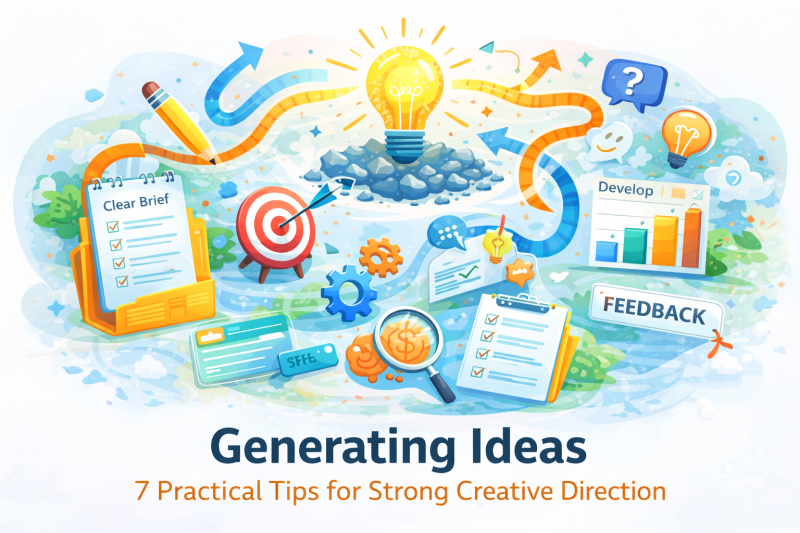
Great ideas rarely arrive fully formed. They are discovered, challenged, reshaped, and refined. If you are working on a brand, website, campaign, or product, learning how to generate and develop ideas properly is one of the most valuable skills you can build.
Here are seven essential principles that help turn early concepts into strong, usable ideas that actually support your goals.
1. Never Settle for Just One Idea
If you have one idea, you probably have a starting point — not a solution.
Strong creative work almost always begins with multiple options. Generating several ideas allows you to compare, improve, and combine them. It also prevents you from becoming emotionally attached too early, which can limit progress.
Think of your first idea as a draft, not a destination.

2. Start With a Clear Brief
Before generating ideas, you need a brief — even a simple one.
A brief does not need to be complex. One or two sentences is often enough, as long as they clearly define:
-
What you are trying to achieve
-
Who it is for
-
What problem you are solving
This structure gives your ideas direction and keeps creativity focused instead of random.
3. Look for Ideas Everywhere
Inspiration rarely appears on command. It comes from observation.
Once you start paying attention, ideas will surface during everyday moments — while commuting, scrolling, watching, reading, or doing routine tasks. The key is to stay curious and question what you see around you.
Good ideas often come from unexpected places, so avoid dismissing early thoughts too quickly.
4. Test Ideas Against the Brief
Creativity still needs discipline.
As ideas emerge, check them against your brief. Ask:
-
Does this solve the problem?
-
Does it support the goal?
-
Can it be adapted if it’s not quite right?
Not every idea needs to be perfect, but it should have the potential to fit with refinement.

5. Push, Pull, and Reshape Your Ideas
This is where real creativity begins.
Take your ideas and challenge them. Change their scale, tone, format, or message. Combine elements from different ideas. Strip them back and rebuild them.
At this stage, nothing is final. You are exploring possibilities, not delivering finished work.
6. Invite Feedback — But Use It Wisely
Fresh perspectives matter, especially once you’ve spent time developing ideas.
Share concepts with people you trust and listen carefully. Feedback will vary, and not all of it needs to be acted on. The goal is not approval, but insight.
Treat feedback as information, not instruction.
7. Narrow Down and Move Forward
Eventually, you need to choose.
Review your ideas and focus on the ones that:
-
Align best with the brief
-
Generate the most enthusiasm
-
Have clear potential for development
You don’t need to delete weaker ideas — archive them. Many good concepts resurface later in different forms.
Once selected, you can begin refining details such as messaging, structure, typography, and colour.

When Ideas Stall
Creative blocks happen. If you find yourself looping without progress, it may be time to step back or seek expert input.
A structured Brand Strategy process can help bring clarity, align ideas with business goals, and turn creative thinking into actionable direction.
Final Thought
Ideas are not rare — strong ideas are built.
By generating multiple concepts, working to a clear brief, staying open to inspiration, and refining with intent, you create ideas that are not only creative but effective.
Now you’ve earned that cup of tea.