
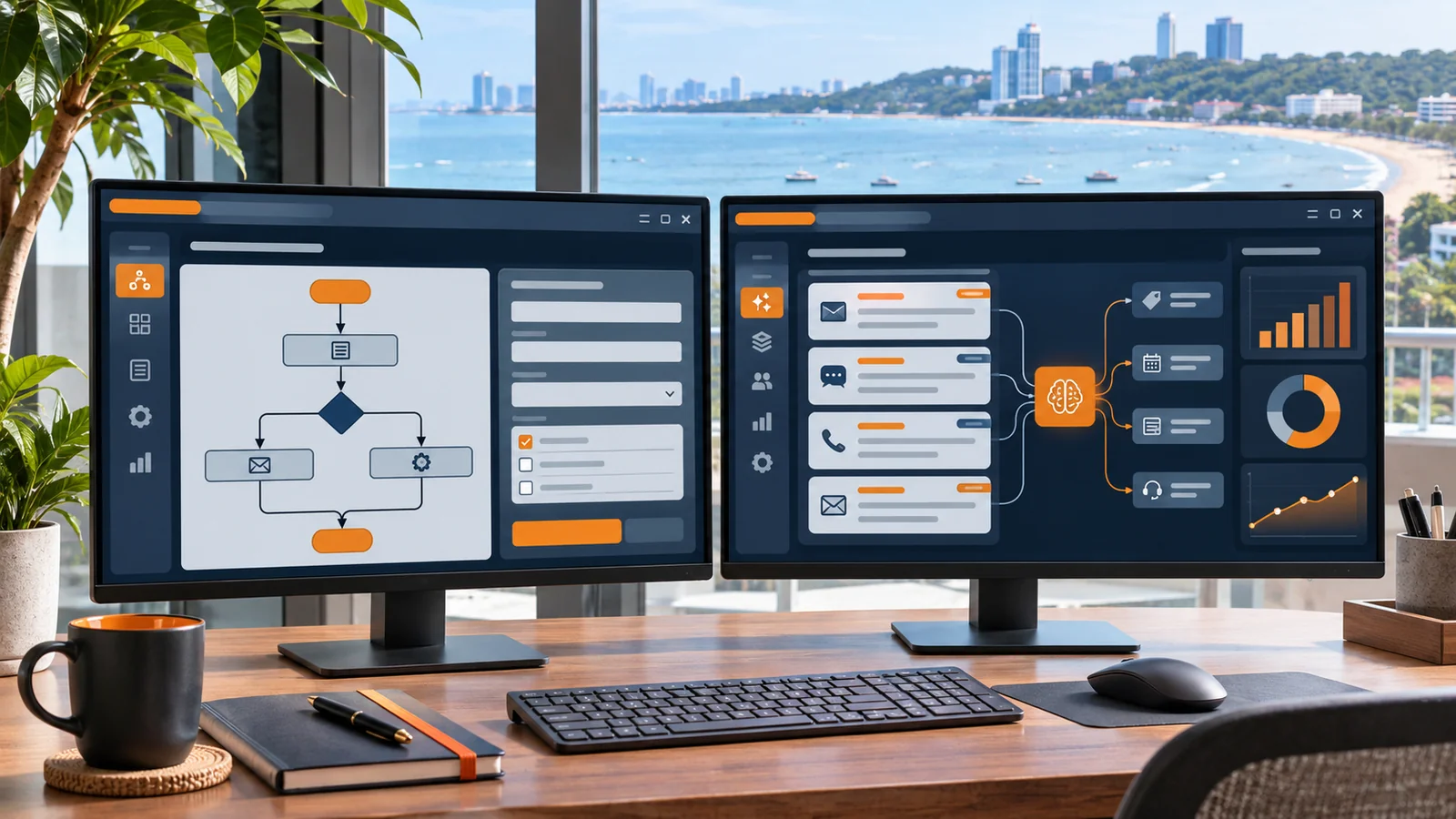
AI automation vs traditional automation is an increasingly important comparison for small businesses looking to work more efficiently. Both approaches can reduce repetitive administration, improve information handling and connect existing software. However, they solve different types of problems.
For a business in Pattaya, the question is not simply whether artificial intelligence can automate a task. It is whether AI offers enough additional value to justify the cost, complexity and oversight involved.
Sometimes, a straightforward software rule is the best solution. Other situations benefit from AI-assisted interpretation, particularly when incoming information varies from one customer to another.
This guide explains the differences, compares practical business applications and shows how to choose an appropriate approach without introducing unnecessary technology.
What Is Traditional Business Automation?
Traditional automation uses predefined rules to complete a task when specific conditions occur.
For example, a customer submits a website enquiry. The website checks the required fields, records the submission and sends a notification to the appropriate email address.
The workflow follows instructions that someone has already defined.
Traditional automation works particularly well when inputs and expected outcomes are predictable.
Common examples include:
- Sending a confirmation message after receiving a form.
- Creating a task when a customer submits a request.
- Moving approved information between connected applications.
- Producing scheduled reports using existing business data.
- Sending an internal reminder when a deadline approaches.
These tasks may require software integrations and careful configuration. However, they do not necessarily need artificial intelligence.
Traditional automation is often easier to test because developers can define what should happen for each condition.
That does not mean it is automatically simple. A workflow involving several systems, unreliable data or complicated business rules can still require significant development and maintenance.
What Is AI Automation?
AI automation adds artificial intelligence to a workflow where interpretation or analysis may provide value.
Instead of relying entirely on predetermined conditions, the system might use an AI model to classify an incoming message, extract information from a document or suggest a response.
Consider a service business receiving customer enquiries.
One customer writes, “I need someone to look at a problem with my website.”
Another says, “Our contact form stopped working and we’re losing enquiries.”
Both requests may need technical support, but they use different wording.
An AI-assisted workflow could suggest a suitable category for each message. The system could then route the enquiry using ordinary software rules.
The important distinction is that AI interprets the information, while the surrounding workflow controls what happens next.
Businesses should still validate the results. AI systems can misunderstand requests or produce inaccurate interpretations.
For that reason, human review remains valuable, particularly when the workflow affects customers or important business records.
AI Automation vs Traditional Automation: Key Differences
The right choice depends on the information involved and the consequences of getting it wrong.
| Consideration | Traditional automation | AI-assisted automation |
|---|---|---|
| Best suited to | Predictable, structured tasks | Variable text and less structured information |
| Decision-making | Defined conditions and rules | Model-generated interpretations or suggestions |
| Consistency | Usually predictable for the same inputs | Outputs may vary, depending on the model and configuration |
| Accuracy | Depends on rules and data quality | Requires evaluation of model errors and reliability |
| Running costs | Software, integration and hosting costs | May add model usage, evaluation and monitoring costs |
| Maintenance | Rule and integration updates | Integration updates plus model and output monitoring |
| Human review | Based on business risk | Often important for uncertain or consequential outputs |
Neither approach is universally better.
For example, a scheduled website backup should generally use established backup software and predictable scheduling. An AI model adds little value to the basic task.
By contrast, an internal process that needs to organise hundreds of differently worded customer messages may benefit from AI-assisted classification.
The decision should follow the task, not the popularity of the technology.
When Traditional Automation Is the Better Choice
1. The Process Follows Clear Rules
If a business can describe the task as “when this happens, perform that action”, conventional automation may be sufficient.
For instance, a local company might want every new website enquiry to generate an internal notification.
The trigger and required action are clear. A standard form integration can usually handle the process without AI.
2. The Information Has a Consistent Structure
Structured information is often straightforward for ordinary software to process.
Dates, order identifiers, customer reference numbers and clearly labelled form fields can support predictable workflows.
Before adding an AI component, check whether better field validation or an existing API could solve the problem.
3. The Result Must Be Repeatable
Some business operations need consistent results.
Creating an invoice from approved figures, recording a payment status or applying a clearly defined discount should rely on reliable business logic.
AI should not invent amounts, alter transaction records independently or replace established accounting controls.
4. The Business Needs Lower Complexity
Small businesses often have limited technical resources.
A conventional workflow may be easier for staff to understand, maintain and troubleshoot. It may also avoid unnecessary model usage charges.
This makes traditional automation a sensible first option for many routine administrative tasks.
When AI Automation Can Be More Useful
1. Customer Messages Use Different Wording
Customer enquiries rarely follow a perfect template.
An AI model may help identify the subject or intended department of a message, even when the customer uses informal language.
However, a reliable workflow still needs rules for low-confidence classifications, missing information and human handover.
2. Documents Contain Variable Information
Businesses sometimes receive invoices, request forms or other authorised documents in different layouts.
AI-assisted extraction may help locate specific fields or prepare summaries.
However, the business must verify important information before storing it or using it to trigger consequential actions.
3. Staff Need to Organise Written Information
An internal tool might summarise approved support requests, group similar questions or help employees locate relevant documents.
This can reduce the effort involved in finding information.
Yet the underlying documents must remain accurate and current. Staff also need suitable permissions and access to the source material.
4. The Workflow Benefits From Language Understanding
A multilingual business in Pattaya might receive enquiries in English, Thai and other languages.
AI assistance may help staff interpret or categorise those messages, although translations and important customer-facing responses require appropriate verification.
In each case, AI is a component of the workflow rather than a replacement for the whole process.
A Pattaya Business Example: Handling Website Enquiries
Imagine a property business receiving customer enquiries through its website.
Some customers request information about a particular property. Others ask about a viewing, financing arrangements or general availability.
The business currently reads each message, identifies the enquiry type and forwards it to the appropriate team member.
There are three possible approaches.
Option A: Traditional Automation
The website form asks customers to select an enquiry category.
If someone chooses “Property Viewing”, the system notifies the relevant team.
This approach is predictable and relatively straightforward, assuming the website and notification systems support the integration.
However, customers may choose the wrong category or leave important information in a free-text message.
Option B: AI-Assisted Automation
The form allows customers to describe their requirements.
An AI model attempts to classify the message and suggest the most suitable team.
This offers flexibility, but the business must account for classification errors and uncertain results.
Option C: Hybrid Automation
The business combines structured form fields with optional AI assistance.
The website records essential information through clearly defined fields. AI then helps categorise additional comments.
Software rules determine the next step, while staff review requests that require judgement or contain uncertain information.
For this example, a hybrid workflow may offer a useful balance between flexibility and control.
The example is illustrative, not a claim about a completed client project. The best implementation would depend on the actual website, customer data and available software integrations.
Why a Hybrid Approach Often Makes Sense
The debate about AI automation vs traditional automation can create the impression that businesses must choose one or the other.
In practice, the two approaches often complement each other.
A well-designed hybrid process might follow this sequence:
- Receive: A website form captures an enquiry and checks required fields.
- Interpret: AI suggests a category for the free-text information.
- Validate: Software rules check that the suggested action is permitted.
- Approve: Staff review uncertain or consequential requests.
- Act: Approved integrations create a task or notify the relevant person.
- Monitor: The business records errors and reviews the workflow’s reliability.
This architecture limits the amount of work assigned to the AI model.
It also makes the process easier to investigate when something fails.
Businesses exploring this approach can learn more about our AI Automation Pattaya service, which covers workflow assessments, integrations and human-supervised automation planning.
What Are the Costs of AI Automation vs Traditional Automation?
Costs depend on the project, so businesses should avoid assuming one approach is always cheaper.
Traditional automation can involve setup, software licences, API subscriptions, hosting and ongoing maintenance.
AI-assisted workflows may introduce additional expenses, including model usage, data preparation, testing, output verification and monitoring.
A business that handles a small number of enquiries might not justify a custom AI system.
On the other hand, a larger operation with many variable requests may find that AI-assisted classification is worth evaluating.
Before comparing costs, establish what the current process requires.
Measure the work involved, the frequency of mistakes and the time staff spend correcting or transferring information.
Then compare those findings with the total cost and reliability of the proposed solution.
The goal is not to minimise the cost of every individual task. It is to improve the overall process without creating unacceptable risks or complexity.
Security, Accuracy and Human Oversight
Automation can cause problems when a workflow has excessive permissions or inadequate safeguards.
For example, a system should not modify sensitive customer records simply because an AI model interpreted a message as an instruction to do so.
Appropriate controls may include validation, restricted API permissions, audit records and staff approval.
The NIST AI Risk Management Framework provides guidance for organisations assessing AI-related risks. Its approach encourages businesses to understand the intended application, measure relevant risks and manage them throughout the system’s lifecycle.
Businesses should also consider what happens if a connected platform becomes unavailable, a model returns an unsuitable answer or a workflow processes the same request twice.
Good automation includes a safe failure process, not just a successful demonstration.
How Should a Small Business Choose?
Before investing in either approach, complete a basic workflow assessment.
Step 1: Identify the Repetitive Task
Choose a process that staff perform regularly.
For example, focus on incoming enquiries, recurring internal reports or repeated data entry.
Avoid trying to automate an entire business department in one project.
Step 2: Examine the Inputs
Review the information involved.
Does the task use consistent form fields and defined values? Or does it require staff to interpret unpredictable written requests?
Structured inputs often favour traditional automation.
Variable language may justify evaluating AI.
Step 3: Define the Required Outcome
Establish exactly what a successful process should produce.
This could be a correctly categorised enquiry, an internal notification or a verified record update.
If the outcome remains unclear, improve the process definition before selecting technology.
Step 4: Assess Risks and Integrations
Check software compatibility, API permissions, data sensitivity and the potential impact of an error.
Consider whether staff must approve particular actions.
Step 5: Test a Small Workflow
Build or assess one limited process using realistic examples.
Measure accuracy, reliability, staff involvement and operating costs.
Expand only when the results justify further investment.
For broader planning, our AI Agency Pattaya page explains how businesses can assess AI opportunities before committing to development.
Where Do Custom AI Tools Fit?
Some businesses cannot achieve their objectives through an existing automation platform alone.
They may need a custom interface, specialised data handling or an integration between systems that do not naturally communicate.
These requirements involve software engineering as well as workflow design.
They may require custom APIs, authentication, testing, hosting and ongoing technical support.
For businesses considering those requirements, our AI Development Pattaya page outlines the technical factors involved in assessing custom AI-supported applications.
However, custom development should follow a feasibility review. It is rarely the best starting point when a simpler software feature already meets the requirement.
Frequently Asked Questions
Is AI automation better than traditional automation?
Not automatically. Traditional automation is often better for predictable tasks and structured information. AI automation can add value when a process requires interpretation of variable text or documents. The best solution depends on the task and risks involved.
Is traditional automation cheaper than AI automation?
It can be, particularly for simple workflows. However, costs vary with integration complexity, software licences and maintenance. AI may introduce model usage and additional testing expenses.
Can a small business use both types of automation?
Yes. A hybrid workflow can combine predictable software rules with AI-assisted classification or information extraction. This allows AI to support selected tasks while ordinary software controls approved actions.
Does AI automation require human supervision?
The level of supervision depends on the application. Businesses should maintain appropriate oversight where errors could affect customers, payments, sensitive information or important business records.
Can WordPress support business automation?
WordPress provides hooks and APIs that can support integrations, depending on the site’s configuration and installed software. Actual feasibility depends on permissions, security requirements and the business process.
Can businesses connect automation with LINE or a CRM?
Some integrations are possible through supported developer APIs and authorised accounts. Available functionality varies by provider, platform restrictions and the intended workflow.
What should a small business automate first?
Start with one repetitive task that has a clear beginning, defined inputs and a measurable outcome. Customer enquiry routing or recurring internal notifications may be suitable candidates, depending on the existing systems.
Final Thoughts: Choose the Simplest Reliable Solution
The choice between AI automation vs traditional automation should begin with a business problem, not a technology trend.
Traditional automation remains valuable for predictable tasks. AI can help when workflows involve variable language, document interpretation or information that is difficult to classify using fixed rules.
In some cases, a hybrid approach offers the most practical solution.
For a Pattaya business, the best starting point is a clearly defined task, a realistic assessment of available systems and a measurable improvement.
Need help assessing a workflow?
Proactive Marketing Solutions provides digital marketing, web development and AI solution planning for businesses in Pattaya and beyond.
Explore our AI Automation Pattaya service or contact us to discuss which approach makes sense for your business.